
Johnners
Brian Johnston – It’s Been a Piece of Cake
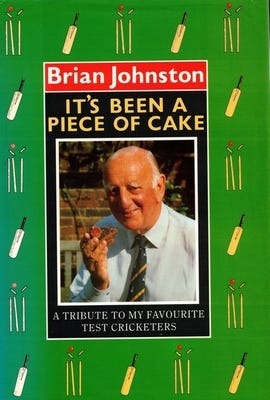
Brian Johnston (1989) – It’s Been a Piece of Cake: A Tribute to My Favourite Test Cricketers, London: Methuen
—
Whenever the current England team is doing badly, the temptation is to romanticise those of the recent past, editing out their failures in order to make comparisons that are unfavourable to their hopeless modern counterparts. If not quite ‘we always used to win’, then at least ‘we used to lose, but we didn’t lose as badly/show so little fight/play so carelessly as this’.
Personally, I don’t mind the defeats as much as the increasingly feral coverage, now duty-bound to factor in the opinions of angry hordes on the internet, and seemingly unable to avoid being carried along with them.
My own rose-tinted spectacles are pointed more in the direction of the ‘good old days’ of the BBC’s Test Match Special, the viral video clips of the current line-up getting cross at an England batsman’s dismissal replaced by the gentle timbre of posh voices enduring a similar setback with cheerful good grace before turning their attentions to a slice of chocolate cake sent in by a lovely listener from Devon.
Even as I start to lapse into these nostalgic reminiscences, I already know that even the timeline of this imagined history is completely off. I started following cricket in 1993: Brian Johnston, the TMS voice that I always imagine chuckling away in these scenarios, passed away early the following year, so I would have heard his commentary during a single summer at most.
My parents would likely have been listening for longer than that, although my own interest in radio coverage of cricket at that point would have been minimal and likely contributed to a general — and inaccurate — feeling that TMS in those days was nothing more than the background noise of some old men chatting away.
It’s Been a Piece of Cake is subtitled A Tribute to My Favourite Test Cricketers, which means that it’s one of those books where the author writes mini-profiles of various famous and successful players and includes a few anecdotes about their personal memories of each one.
Many of those featured here, it has to be said, were not of much interest to me when I first read this book: naturally, there was little crossover between Mike Atherton’s young England side and a lifetime’s collection of favourites from a commentator then approaching his ninth decade.
Another book of the late 1980s,1 the final pages of It’s Been a Piece of Cake again feature an evaluation of the fading fortunes of the decade’s leading lights for England: Botham, Gooch, Gatting and Gower.
At the time of the book’s writing, Gooch had been named as captain for the 1988/9 winter tour of India, only for the tour to be cancelled after several players, including Gooch, were denied a visa due to their links with South Africa.
Apparently considering this a blessing in disguise and expecting – correctly – that either Gatting or Gower would be restored to lead England in the 1989 Ashes, Johnston is perhaps guilty of underestimating Gooch’s qualities as leader, although his comments also appear prescient of the 1993 tour, which went so badly for Gooch and the team: ‘It is all past history now, but at the time I wondered whether it was a good idea to send someone to lead a side in India who would basically rather not go.’
Meanwhile, Ian Botham’s decline as a bowler during the decade is noted, albeit with accompanying good wishes for his recovery from a serious back injury and the hope that he will return to serve England again as a more patient batsman and occasional seamer.
Mainly, though, It’s Been a Piece of Cake is focused on an era of cricket beyond my frame of reference or understanding: of Gentlemen and Players, and careers interrupted by World War II.
As for Johnston himself, he does note if any players have featured in any of his famous commentary gaffes, including the notorious (and possibly apocryphal) instance featuring Michael Holding and Peter Willey. There are also nods to the post-playing careers of those who later joined him in the TMS box, including Trevor Bailey and Fred Trueman, both of whom endured into the post-Johnston era.
This is largely a gentle book of fun and fond reminiscences, with many players given nicknames ending in ‘ers’ — similar to his own, ‘Johnners’ — even if it doesn’t actually shorten the original name: Boycers, Gatters, Bothers, Brealers, etc.2
But opinions on the state of the modern game are offered, mainly through the final chapter entitled ‘Last Over: For Better, For Worse’, in which evergreen ills such as poor batting technique, the malign influence of one-day cricket and the reverse sweep are named as blights on the game.
Whether Johnners ever spoke quite so extensively about such topics on the radio, or whether this is an indulgence of a book bearing his name, I’m not sure. But he certainly does remark that, on balance, the modern game is not as good to watch as it used to be. It never is, is it?
—
Next time: Mike Atherton — Opening Up
Most of the books I inherited were published no later than 1990 but, eager for information about current players, I naturally gravitated towards the newest ones just in case. As for the rest, although I was prepared to venture back through the 80s and even slightly earlier, my young mind decided that David Frith’s book (written with Greg Chappell) covering the 1977 Ashes was as far back as I was prepared to go, possibly because that was when Star Wars came out and that was the oldest film I was happy to watch. I’m past such silly rules now, of course: I’ll even watch Jaws.
There are lots of exclamation marks, too, which seem to be a function of age. I never used to use them, but now find myself doing so all the time!