
The Pundit
Geoffrey Boycott – Boycott on Cricket
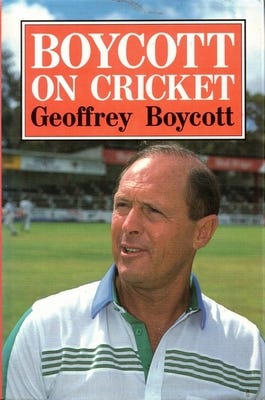
Geoffrey Boycott (1990) – Boycott on Cricket, London: Partridge Press
—
To the younger sports fan, older pundits are little more than TV characters, their playing careers a mere footnote predating the current generation’s interest in the game. In 2016, the BBC showed footage of Euro ‘96 to people born in 1996: during the memorable 4-1 group defeat of the Netherlands, one made a comment to the effect that she couldn’t believe that bald bloke off the telly — Alan Shearer — was once the premier striker in the land.
And so for me, back in the 90s, Geoffrey Boycott was just a man with a booming Yorkshire voice, aged somewhere between 40 and 70, who appeared on television coverage of cricket to criticise poor batting technique and occasionally put his car keys into the pitch.
Although later stereotyped as perennially grumpy and at odds with the modern game, his observations at that point seemed sharp and relevant: despite being of a different generation to those out in the middle, he still seemed to think like a player, often referring to himself in the present tense as ‘a batsman’, as if he could still put on his whites and make himself available to open the innings if needed.
Boycott On Cricket – one of a number of other books by or about Boycott (although not, curiously, his actual autobiography) that I inherited in the summer of 1994 – certainly helped fill in the blanks.
Although released only a few years earlier, the dapper, smartly attired, sunhat-wearing Boycott of Sky’s TV coverage was nowhere to be seen, with the book’s cover instead picturing a more casually dressed, younger-looking man, apparently mid-anecdote/opinion, as if to emphasise the fact that its author has some firm views, and will be sharing them in the pages within.
That promise is certainly fulfilled. Boycott on Cricket was my very first experience of the phenomenon known as ‘retired player thinks modern game has gone to the dogs, produces manifesto for change’, and though it spoke of a slightly different era to the one with which I was growing up, its frankness on the issues of the day was rather bracing.
Talk of a crisis in English cricket rarely dissipated during the 90s and remains a recurrent theme following any defeat or tournament exit. However, this book makes a strong case at the outset by stating that as the 80s came to an end, England had been victorious in just one Test out of their last 25, with that win coming at home against Sri Lanka, who had only been awarded Test status in 1981. You can say what you like about cherry-picking and weaponising statistics to make a point,1 but there’s not much getting around that one.
Boycott continues: ‘Following defeat at the hands of a well-organised, determined Australian team [in 1989] … there was a widely held view that it would be better to abandon the proposed West Indies tour to avoid further humiliation … selection for the trip [was] regarded as the equivalent of the death sentence’.
Regardless of whether such a view was indeed widely held, England exceeded expectations on that tour, pulling off a shock victory in the first Test, and battling hard for the rest of the series before ultimately losing 2-1. Boycott had been brought into the fold to provide batting coaching prior to the trip, although during the series itself he was working in the media, fulfilling commentary duties for Sky.
This coaching experience leads him to observe here that he was dismayed by the general standard of batting among those selected, and for good measure he pulls apart the techniques of several top batsmen of the era, including county run-makers who had already struggled in Test cricket like Tim Curtis and Kim Barnett and future 90s stalwarts Nasser Hussain and Mike Atherton, then promising youngsters. Graham Gooch is also grouped in with the older failures, perhaps reflecting his uncertain status in the team prior to his late career renaissance.
The efforts of the team in the West Indies remain largely unacknowledged: rather than claim any credit for their improved showing, Boycott is instead disappointed to find England batsmen succumbing to the same flaws he had previously identified. Although not picked apart quite so specifically as the others, Alec Stewart (also a 1990 debutant) and Mark Ramprakash (yet to play for England but attracting attention at county level) are also found to be lacking in Boycott’s eyes.
These critiques are pretty fleeting, however, compared to the attention focused on Ian Botham and David Gower, each worthy of a whole chapter. The outlook forecast by the author is bleak for both, although the criticism of Botham seems more personal, seemingly based on Boycott’s alleged observation of bullying and duplicitous behaviour by the great all-rounder while a young captain on the 1981 tour of the West Indies.
Of Gower, Boycott seems more exasperated by his laid-back demeanour than anything else, suggesting that his omission from the England side should be a wake-up call, that he should earn his place back by weight of county runs, and as an experienced player he should be batting up the order, or even opening.2
Elsewhere, while Boycott states that he does not want all England batsmen to bat like him, there are times when the opposite seems true. Like many supposed ‘plans for change’ from pundits, Boycott on Cricket is less of a coherent plan and more a collection of strident opinions which occasionally resonate and even prove prescient: the introduction of neutral umpires, the dropping of Test cricket’s rest day, and the commercial potential of day-night Tests are all mentioned here.
At other times, they actively contradict each other in the way that such opinions often do: were players dropped too frequently from the England team, or not frequently enough? If county cricket, and its coaches, were so awful, why should proven or potential international cricketers be left there to fester?
The voice on these pages feels like an angrier Boycott than the TV pundit of a few years later, possibly stemming from a bubbling sense of injustice on multiple fronts: that his retirement as a player in 1986 was Yorkshire’s decision, not his; that the young Botham rarely consulted him as captain, nor was he considered for the position of vice-captain, on that 1981 tour; or that the nature of his coaching arrangement with England was limited and informal. Even as a pundit, he was not in great demand until Sky contracted him for that West Indies tour in 1990.
The last third or so of the book is focused almost entirely on Yorkshire County Cricket Club and its seemingly never-ending political infighting, spanning from Boycott’s unhappy captaincy during the 70s through to the attempts to sack him as a player in the 80s before ending in a lengthy tale of contemporary committee wranglings.
Such topics were incomprehensible to me as a teenager, and remain so in the present day, although just as I was wondering whether I had misremembered some choice words directed at the Yorkshire batting pair of Martyn Moxon and Ashley Metcalfe, they popped up in the middle of all this. Perhaps unsurprisingly, this criticism is framed in the context of neither player ever taking, or asking for, his advice: meanwhile, it is noted that teammate Richard Blakey – who did seek Boycott out – scored a big double hundred on the England ‘A’ tour of Zimbabwe in 1990.3
It was the Boycott of his earlier tour diaries of the late 70s and early 80s – Put to the Test, Opening Up and Life in the Fast Lane – that humanised him to me, painting a picture of a great player at the tail end of his England career attempting to maintain his high standards at the age of 40.
In his later commentary work, Boycott was always best when offering balanced and measured feedback – which he often did – but the media character that was later created, a prototype of which is in evidence here, ultimately became the one that endured.
—
Next time: Brian Johnston — It’s Been a Piece of Cake
‘If you take away all of this player’s big scores, then his average is actually pretty low’ etc.
Gower had already moved himself up to open in England’s second innings at Trent Bridge during the previous Ashes summer, following on after Australia had piled up over 600, although he made few runs and the experiment was not repeated.
Blakey was considered an up-and-coming batsman at this point, and though he did go on to represent the full England team, it was a brief and chastening experience as backup wicketkeeper to Alec Stewart on the tour of India in 1993.